
Dear AFT Guild SDCCD Faculty Members,
We have finally reached the point where our proposal is ready to go! We do appreciate all of the feedback we have received to date. Now the time has come to start the negotiation process with the District!
Attached please find our final draft, in addition to updated salary schedule and department chair reassigned time matrices.
Please keep your eye out on your inbox tomorrow afternoon for a poll from: AFT Guild Local 1931 <invitations@mail.electionbuddy.com>. This poll is set to send out tomorrow afternoon to all SDCCD AFT Guild members where you will be asked to cast your vote in support or opposition to this initial proposal. Your AFT Guild Executive Council Members are clearly urging a “YES” vote when you receive this poll.
In Solidarity,
Amy Alsup, Andrea Sperling, Elissa Claar, Eliza Rabinovich, Geoffery Johnson, Heather Paulson, Ian Duckles, Jennifer Cost, Jessica Thompson, Jim Mahler, Jim Miller, John Bromma, Kelly Mayhew, Kirsten Lachenmayr, Lee Blackmore, Lisa Chaddock, Marne Foster, Olivia Flores, Pegah Motaleb, Reem Putrus, Ryane Willis, Sarah Boswell, Soon-Ah Fadness, Tawny Whaley
AFT Guild, Local 1931 SDCCD Faculty Executive Council Members
Begin forwarded message:
From: Jim Mahler <aftjim@mac.com>
Subject: UPDATED Version of AFT Guild SDCCD Faculty Initial Contract Proposal
Date: May 11, 2026 at 2:35:01 PM PDT
Cc: Kelly Mayhew <kmayhew@sdccd.edu>, Jessica Thompson <jethomps@sdccd.edu>, Ian Duckles <iduckles@sdccd.edu>, Eliza Rabinovich <erabinovich@sdccd.edu>, Olivia Flores <oflores@sdccd.edu>, Tawny Whaley <twhaley@sdccd.edu>, Lisa Chaddock <lchaddoc@sdccd.edu>, Pegah Motaleb <pmotaleb@sdccd.edu>, Soon-Ah Fadness <sfadness@sdccd.edu>, Jennifer Cost <jcost@sdccd.edu>, Jim Miller <jmiller@sdccd.edu>, Amy Alsup <aalsup@sdccd.edu>, Geoffery Johnson <gjohnson@sdccd.edu>, Heather Paulson <hpaulson@sdccd.edu>, Andrea Sperling <asperlin@sdccd.edu>, Elissa Claar <eclaar@sdccd.edu>, Marne Foster <mfoster@sdccd.edu>, John Bromma <jbromma@sdccd.edu>, Sarah Boswell <sboswell@sdccd.edu>, Reem Putrus <rputrus@sdccd.edu>, Ryane Willis <rwillis@sdccd.edu>, Kirsten Lachenmayr <klachenm@sdccd.edu>, Lee Blackmore <lblackmo@sdccd.edu>, Yvonne <aftyvonne@gmail.com>, Larissa <aftlarissa@gmail.com>
Dear SDCCD Faculty AFT Guild Members,
We truly appreciate all of the feedback we have received both in-person and via email over the past three weeks regarding our draft initial contract proposal.
Since that date, we have made many revisions to the proposals based on the feedback we have received. Here is a summary of the most substantive changes:
§5.2.7 – Adds Language for Adjunct Faculty Termination/Due Process Procedures per recently enacted legislation Ed Code §87667.
§7.1.6 (new): Faculty compensated at non-classroom hourly rate for flex time completed beyond their required obligation, up to 20 additional hours per academic year.
§7.1.7 (new): Each college must establish and maintain four specific positions at 1.0 FTEF each: Professional Learning Coordinator, Instructional Designer, Distance Education Coordinator, and Instructional Technologist.
Class Size Caps revisions include:
- Adds foreign language, ESL, and AMSL courses to the 25-student cap category (alongside CAL-GETC 1A/1B)
- Adds “Baccalaureate Program” courses to the 25-student cap
- Reduces the CAL-GETC Area 1C cap from 30 to 28 students
- Changes oversize lecture section load credit formula from “Class Cap ÷ 35 X FTEF” to a new formula: ((Class Cap ÷ 35) – 1) × 1.0 ESU
- Adds a new rule: class caps may not exceed the cap of a similarly situated in-person class
- Adds a Study Abroad cap: maximum 15 students per accompanying faculty member
§7.11.5 (new): All other faculty assignments during summer/intersession (e.g., hiring committees) must be compensated at the non-classroom hourly rate if outside the contracted assignment. Adjunct faculty must be compensated for required department/school/college meetings.
§7.12.6 (new): Specifies that several Allied Health program directors (Physical Therapist Assistant, Veterinary Technology, Health Information Management, etc.) shall have 11-month assignments.
Salary Transition Rules: adds an explicit phased transition for the new salary column structure:
- Faculty on Current Salary Classes 0–2 → New Column I
- Faculty on Current Classes 3–4 → New Column II
- Faculty on Current Classes 5–6 → New Column III
- If a degree warrants a higher column, faculty move to the higher Column
Updated Salary Column Qualifications
New addition: A districtwide study committee will be convened to determine appropriate salary placement parameters for CTE faculty in disciplines where advanced degrees are not generally available.
Adds a 10-year phase-in for maximum initial step placement (Step 2 in year 2 after ratification, increasing by 1 step per year until reaching Step 10 in year 10).
Adjunct/Overload Salary Schedule – Step Advancement: Instead of years of service at Step F (e.g., “2 years or more → Step 8”), this version replaces this with District service hours (e.g., 2,700+ hours → Step 7, 3,150+ hours → Step 8, up to Step 25).
§9.1.2.1: Expands Program Director eligibility to include all CTE programs (as defined by the California Chancellor’s Office) and programs with required embedded industry certifications (not just accredited programs). Increases minimum reassigned time for program directors from 20% to 40% FTEF per semester.
Language Courses (B/C 13.0): Clarifies that the multi-level simultaneous teaching compensation applies to “Tenured/Tenure-Track and Adjunct faculty;” also specifies that for combined lecture/lab courses, only the lecture portions are considered for the multi-level compensation.
Bilingual Stipend (B/C 15.0 – entirely new section): A new 5-section provision creating a bilingual stipend (5% additive to base monthly pay) for non-classroom unit members whose assignments require bilingual skills, subject to Dean certification and a District proficiency exam.
§10.5 (new): Expands District Flex Plan provision (IRS Code §125), to allow adjunct faculty to earmark pre-tax dollars for health care and dependent care expenses.
Article XVI – Transfers/Upgrades – Allows POA adjunct faculty with six years or more at 0.40 FTEF and satisfactory evaluations to apply for a “transfer” into vacant tenure-track positions when they become open. Department can recommend to college President to accept request or direct them to apply through the regular process.
Article XXVI – Artificial Intelligence (Significant Reorganization)
Miscellaneous:
- Replaces per-semester reassigned time for hiring committee chairs (0.20 FTEF) with 1.0 ESU for each search committee member during an active search
- Adds ½ ESU per unique course per semester for outcomes assessments, distributed by mutual agreement
- Adds 0.40 FTEF Reassigned Time for a Sustainability Coordinator at each college
Department Chair Listing and Reassigned Times were updated. (attached)
The foregoing is just a summary of changes. Please take the time to read through the attached Word document and let us know if there is anything we missed or that needs to be updated.
Our hope is to finalize this document within the next week or so and then put it out for a vote for our members to approve before we actually begin the negotiation process with the District. Speaking of which, at this Thursday’s Board meeting we will be carrying out the first legally required step in that process by providing the Board of Trustees with an outline of these negotiation topics we intend to pursue. We hope to see you there in support!
In Solidarity,
Amy Alsup, Andrea Sperling, Elissa Claar, Eliza Rabinovich, Geoffery Johnson, Heather Paulson, Ian Duckles, Jennifer Cost, Jessica Thompson, Jim Mahler, Jim Miller, John Bromma, Kelly Mayhew, Kirsten Lachenmayr, Lee Blackmore, Lisa Chaddock, Marne Foster, Olivia Flores, Pegah Motaleb, Reem Putrus, Ryane Willis, Sarah Boswell, Soon-Ah Fadness, Tawny Whaley
AFT Guild, Local 1931 SDCCD Faculty Executive Council Members
Begin forwarded message:
From: Jim Mahler <aftjim@mac.com>
Subject: First Draft of AFT Guild SDCCD Faculty Initial Contract Proposal – Your feedback requested
Date: April 14, 2026 at 2:00:00 PM PDT
Cc: Kelly Mayhew <kmayhew@sdccd.edu>, Jessica Thompson <jethomps@sdccd.edu>, Ian Duckles <iduckles@sdccd.edu>, Eliza Rabinovich <erabinovich@sdccd.edu>, Olivia Flores <oflores@sdccd.edu>, Tawny Whaley <twhaley@sdccd.edu>, Lisa Chaddock <lchaddoc@sdccd.edu>, Pegah Motaleb <pmotaleb@sdccd.edu>, Soon-Ah Fadness <sfadness@sdccd.edu>, Jennifer Cost <jcost@sdccd.edu>, Jim Miller <jmiller@sdccd.edu>, Amy Alsup <aalsup@sdccd.edu>, Geoffery Johnson <gjohnson@sdccd.edu>, Heather Paulson <hpaulson@sdccd.edu>, Andrea Sperling <asperlin@sdccd.edu>, Elissa Claar <eclaar@sdccd.edu>, Marne Foster <mfoster@sdccd.edu>, John Bromma <jbromma@sdccd.edu>, Sarah Boswell <sboswell@sdccd.edu>, Reem Putrus <rputrus@sdccd.edu>, Ryane Willis <rwillis@sdccd.edu>, Kirsten Lachenmayr <klachenm@sdccd.edu>, Lee Blackmore <lblackmo@sdccd.edu>
Dear SDCCD Faculty AFT Guild Members,
After reviewing hundreds of suggestions and weaving them into what we hope will become future permanent contract language, we are pleased to share with you all the first draft of what will eventually become our initial proposal to begin the negotiation process with the District for a successor Agreement to our current SDCCD/AFT faculty contract which is due to expire on June 30, 2026. This is an exceptionally long email, we hope you will read it all the way to the end and review the attachments.
It is clear that salaries and modifications to the existing salary schedule were the top priorities expressed by our members via the survey, so let us start with describing what we are now proposing with respect to those items.
We first started with what will soon be the single column tenured/tenure-track salary schedule, effective July 1, 2026 (this will tie into the adjunct/overload salary schedule in a moment, please keep reading…):
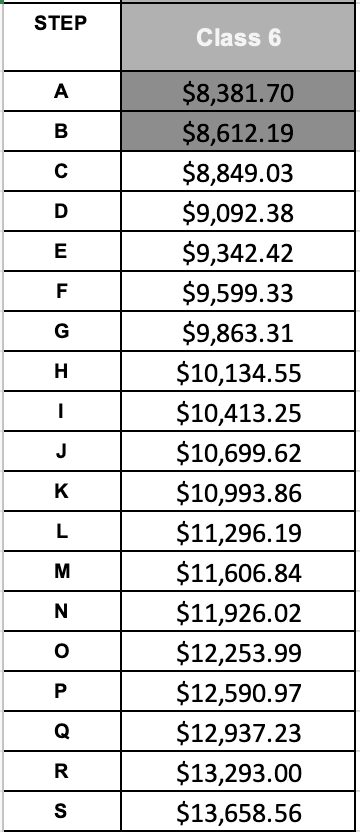
(In case you missed it, all tenured/tenure-track faculty will be moved to this single salary column July 1, 2026.)
Then we considered several factors: 1) Our salaries are among the lowest in the County and the State (largely due to how our District is funded under the current statewide funding formula); 2) The single column does not differentiate for advanced degrees; 3) There currently is not a mechanism for new hires to come in above Step C, regardless of their prior experience; 4) Faculty who were already on Class 6 did not benefit from the most recent settlement; 5) There are approximately 60 faculty already on Step S of Class 6, many of whom have not received a step increase in years.
With these points in mind, we first dramatically increased the values of each of the steps in this single column salary schedule, and added eight additional steps at the high end:
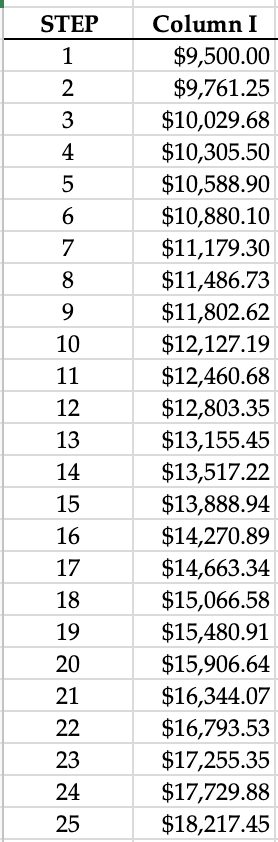
With this new salary column as our new starting point, we would move faculty from the original single column above, to this new single column as follows:
• Current Step C moves to New Step 1
• Current Step D moves to New Step 2
• Current Step E moves to New Step 3
…
• Current Step Q moves to New Step 15
• Current Step R moves to New Step 16
• Current Step S moves to New Step 17
Then, to compensate the faculty who have been stuck on Step S for some time we propose to accelerate them into the newly created additional eight steps as follows:
• Faculty who have been on Step S for two years or more will move to step 19.
• Faculty who have been on Step S for three years or more will move to step 20.
• Faculty who have been on Step S for four years or more will move to step 21.
• Faculty who have been on Step S for five years or more will move to step 22.
• Faculty who have been on Step S for six years or more will move to step 23.
• Faculty who have been on Step S for seven years or more will move to step 24.
• Faculty who have been on Step S for eight years or more will move to step 25.
In recognition of advanced degrees, over and above what is required to meet Minimum Qualifications, we are proposing two additional salary columns, each 2.5% greater than the previous column:
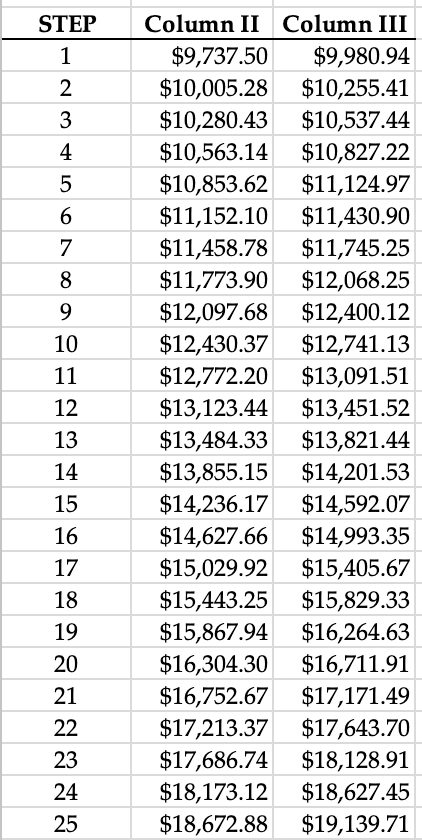
We are proposing the following as the “rules” for placement in each of these three new salary columns:
Salary Column I:
i) Non-credit faculty must meet statewide minimum qualifications as per Title 5, §53412 for non-credit programs.
ii) Credit faculty must meet Minimum Qualifications for Faculty and Administrators in California Community Colleges as published by the State Chancellor’s Office.
Salary Column II:
i) All faculty who hold a second Master’s Degree, if a Master’s Degree was required to meet the minimum qualifications of Salary Column I.
ii) All faculty who hold a Master’s Degree, if a Master’s Degree was not required to meet the minimum qualifications of Salary Column I.
iii) All faculty who hold a Juris Doctorate.
Salary Column III:
i) All faculty who hold a Master’s in Fine Arts, or an earned doctorate (Ph.D., Ed.D., Psy.D., D.B.A, M.D., or equivalent doctoral degree which requires original research, and the completion and defense of a doctoral dissertation).
Lastly, in order to recognize previous related work or teaching experience, we are proposing that any newly hired faculty can be placed up to Step 10, reflecting a maximum credit of ten years of previous work or teaching experience.
Moving on now to the adjunct/overload salary schedules…
**Same rules for Salary Column and Step Placement, in addition to credit for prior related work or teaching experience, would apply for adjunct faculty as stated above for tenured/tenure-track faculty.**
In addition, we developed a 100% pro-rata salary schedule for all adjunct/overload assignments such that adjunct faculty will be paid exactly the same rate of pay, on a proportionate basis, as their equally qualified tenured/tenure-track counterparts who are doing the same work. That means 100% equal pay for equal work.
Following those principles, the adjunct/overload salary schedules we are proposing would look like this:
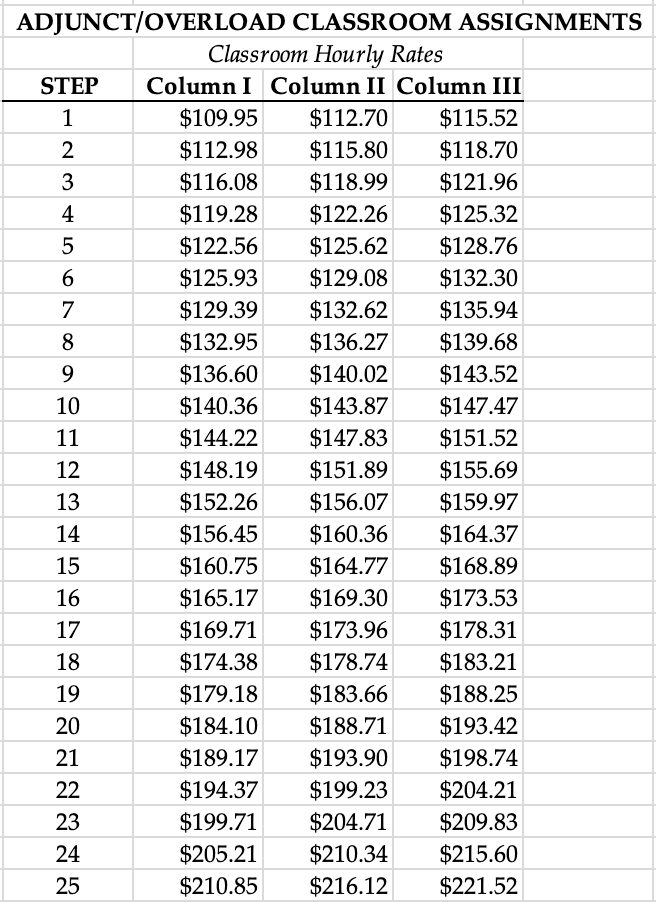
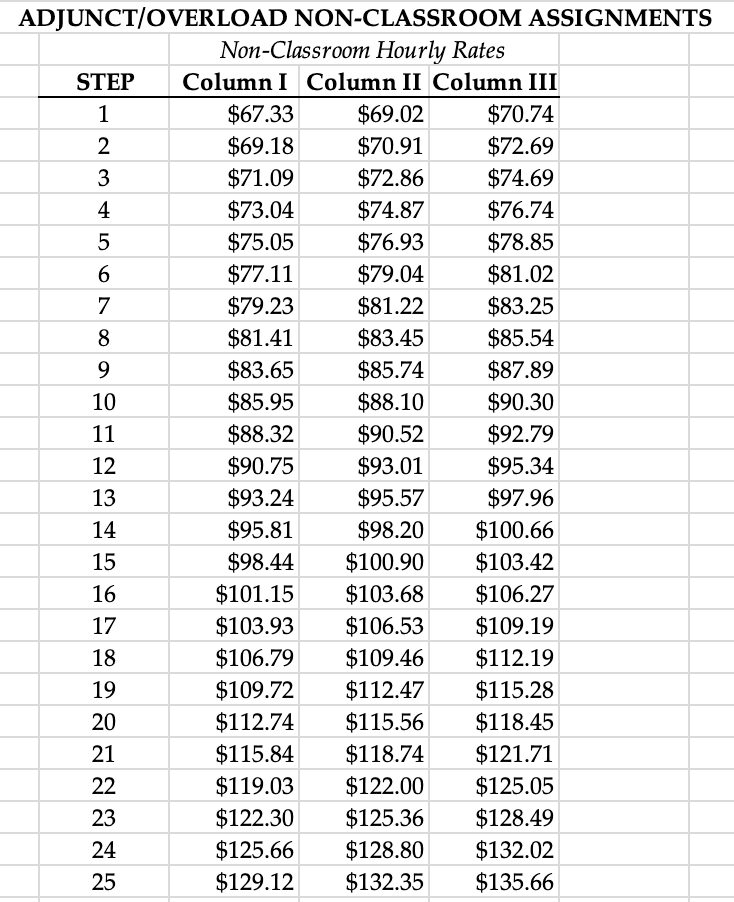
Overload faculty would be placed on the same step/column as they are on the Tenured/Tenure-Track salary schedule. Adjunct faculty will be moved from the current single column model as follows:
• Current Step A moves to New Step 1
• Current Step B moves to New Step 2
• Current Step C moves to New Step 3
• Current Step D moves to New Step 4
• Current Step E moves to New Step 5
• Current Step F moves to New Step 6
Then, to compensate our adjunct faculty who have been stuck on Class 6, Step F for some time we propose to accelerate them into the newly created additional steps as follows:
• Faculty who have been on Class 6, Step F for two years or more will move to step 8
• Faculty who have been on Class 6, Step F for three years or more will move to step 9
• Faculty who have been on Class 6, Step F for four years or more will move to step 10
• Faculty who have been on Class 6, Step F for five years or more will move to step 11
• Faculty who have been on Class 6, Step F for six years or more will move to step 12
• Faculty who have been on Class 6, Step F for seven years or more will move to step 13
• Faculty who have been on Class 6, Step F for eight years or more will move to step 14
And if your head’s not spinning by now, here’s more on salary…
Considering this round of contract negotiations will likely take a considerable amount of time until we reach agreement, and then once we do reach agreement it will take some time for the District to place everyone appropriately on our proposed new salary schedules, we want to get some money in everyone’s pockets as soon as possible so we are also proposing a one-time payment equal to five percent (5%) of your total gross earnings which were earned during the previous 12 calendar months.
And then for future years, we are proposing built-in increases:
• Effective the first July 1st following ratification by the parties, all salary schedules to be increased across the board by the value of the Statewide COLA + 2%.
• Effective the following July 1st, all salary schedules to be increased across the board by the value of the Statewide COLA + 2%.
**What we don’t have in this proposal, and would like to receive suggestions from you on, is some type of financial incentive for professional development.** If you have any innovative ideas, please send them our way.
Moving on to other compensation related items. We are also proposing the following:
• Adding 2 ESUs per semester for all Department Chairs (includes CE).
• Increasing the amount of reassigned time for all departments. (see attached table)
• Merging all CE chair language into that of the credit colleges, including 11-month contracts.
• 1/2 ESU per course per semester for each unique catalog course number the Department Outcomes Coordinator of each department is responsible for.
• Providing additional departmental reassigned time of 0.20 FTEF per discipline during the semester program review is scheduled.
• Increasing in the number of ESUs for head coaches and assistant coaches up to 16 and 8, respectively.
• Expanding the Adjunct Office Hour program to include CE adjunct faculty.
• Each faculty Club Advisor to receive 2 ESUs per semester.
• During semesters in which a unit member is chairing or co-chairing a search committee to fill a tenure-track or restricted contract faculty position, the unit member shall receive an additional 0.20 FTEF Reassigned Time.
• Providing up to $5,000 annually per member for tuition reimbursement.
• Doubling the districtwide travel and conference fund, and expanding use to include professional development activities.
• Providing all CCAP faculty with the 10% off-campus additive, in addition to 10 paid non-classroom hours each semester for professional development, orientation, and high school visits.
• Providing reassigned time for faculty who serve as campus study-abroad coordinators.
• All disciplines to be fairly compensated when teaching multiple levels of the same course at the same time.
Class Size Reduction for Credit Colleges
• No class shall have a class capacity of greater than 35 students.
• Courses that satisfy CAL-GETC Area 1A and 1B will have a class capacity of 25 students.
• Courses that satisfy CAL-GETC Area 1C will have a class capacity of 30 students.
• In cases where a single lecture section serves two lab sections, the class cap of the lecture section may exceed 35, with an additional load factor applied.
• The instructor may raise these aforementioned caps at their sole discretion.
Faculty Benefits
• Makes permanent the choice of at least one fully paid HMO, and maintains current dental and vision coverages.
• Expands the computer loan program to all applicants, not just those whose names are drawn in the lottery.
• Allows faculty to take any SDCCD course tuition free.
• Expansion of the Overload Banking Program.
• Expansion of pro-rata program to include CE tenured retirees.
• Provides clarity on how pro-rata assignments are to be computed, and allows additional assignments up to 40% overall at the adjunct rate of pay.
• Adds paid leave for reproductive loss.
• Allows retiring unit members to purchase a District parking permit and keep their SDCCD email address, subject to annual renewal.
• Updates the FMLA/CFRA/PDL leaves table.
Enhanced Adjunct Faculty Rights
• Adjunct faculty with eight or more years of SDCCD service who are invited to be interviewed by the screening committee shall also be sent to the College President as part of the committee’s finalist pool of candidates.
• ESL adjunct faculty to gain POA for all levels/classes of ESL.
• Adjunct faculty won’t lose their POA by accepting reassigned time opportunities.
• Enhanced adjunct termination protections as a result of CFT legislative changes to Ed Code §87665.
Protecting the Rights of all Faculty
• New contract article on Artificial Intelligence, safeguarding against abuse while protecting academic freedom.
• Non-classroom tenured/tenure-track faculty to be allowed two remote days per week. Non-classroom adjunct faculty to be allowed one remote day per week.
• Defines the principal purposes of the evaluation process.
• Updated language regarding assigned vs. unassigned hours for non-classroom faculty.
• Updated emergency communication system.
• All grievances to be submitted for binding, vs. advisory, arbitration.
• Limits how far back in time the District can go to apply discipline.
• Redefines the Professional Advancement Committee as the Sabbatical Review Committee.
• Hybrid courses re-defined as 50% on-campus for online load calculation purposes, regardless of actual time spent on-campus.
**What’s not Included: Renewal of Resource Allocation Formula (RAF)**
Based on the feedback received, we have purposely chosen to not renew the Resource Allocation Formula (RAF) when it expires on June 30, 2026. With the RAF in place, we would not be allowed to seek all of the economic improvements we are proposing. The biggest downside of not having a RAF in place will mean that we will likely need to pay for our health benefit premium increases when they take effect on January 1, 2027 until we are able to settle this contract.
What happens next?
Keep in mind this is just the first draft of our initial proposal. We have made our best effort to ensure every voice has been heard. We are now sending it out to all faculty to invite your feedback. Feel free to email us any suggested changes or other ideas for improvement. In addition we are in the process of setting up on-site meetings at each college to provide more opportunity for face-to-face interaction and feedback. Those details will be forthcoming as soon as we can confirm rooms.
Attached please find the full proposal in Word. Contract language to be deleted is shown with strikeout text, new language to be added is underlined. The new proposed salary schedules and the proposed department chair reassigned time matrix in Excel are both attached as well.
In Solidarity,
Amy Alsup, Andrea Sperling, Elissa Claar, Eliza Rabinovich, Geoffery Johnson, Heather Paulson, Ian Duckles, Jennifer Cost, Jessica Thompson, Jim Mahler, Jim Miller, John Bromma, Kelly Mayhew, Kirsten Lachenmayr, Lee Blackmore, Lisa Chaddock, Marne Foster, Olivia Flores, Pegah Motaleb, Reem Putrus, Ryane Willis, Sarah Boswell, Soon-Ah Fadness, Tawny Whaley
AFT Guild, Local 1931 SDCCD Faculty Executive Council Members